I guess if you do something solely for the purpose of remaining popular with the extreme right in a red state, it doesn't matter if people who need health care get it or not. Please watch the video from the Rachel Maddow Show, as it explains it very well. HEY JERRY ASKINS!!!! WISH YOU WERE HERE!!!!
Showing posts with label health care. Show all posts
Showing posts with label health care. Show all posts
Sunday, April 17, 2011
Sunday, March 7, 2010
If Insurance Companies Raise Rates, Shouldn't They Be More Transparent About Costs?
Last Thursday (March 4, 2010) Kathleen Sebelius head of Health and Human Services met with top insurance executives of the largest health insurance corporations, including WellPoint CEO Angela Braly and United Health CEO Stephen Helmsley. Executives from Aetna and Cigna insurance companies were also there. This meeting was noted in many major newspapers, including "The Sacramento Bee" by writer Bobby Cain Calvan.
Recently, Anthem Blue Cross (a subsidiary of Angela Braly's company, WellPoint) caused a nationwide fright when they chose to raise rates 39% on thousands of their California customers. Secretary Sebelius is asking these large health insurance companies that if they choose to raise rates they need to post the rates hikes online and also the justification for those rate hikes. And here I quote directly from Bobby Calvan's story:
When The Sacramento Bee newspaper contacted the Insurance Commissioner's Office (Steve Poizner, a Republican candidate for California Governor) Poizner's spokesman responded with an e-mail saying the information (details on rates) was publicly available, but not on the internet. It is only available to view (on paper, not on the internet) in San Francisco and Los Angeles. And here again I quote directly from Bobby Calvan's story in The Bee:
Recently, Anthem Blue Cross (a subsidiary of Angela Braly's company, WellPoint) caused a nationwide fright when they chose to raise rates 39% on thousands of their California customers. Secretary Sebelius is asking these large health insurance companies that if they choose to raise rates they need to post the rates hikes online and also the justification for those rate hikes. And here I quote directly from Bobby Calvan's story:
President Obama was also there and read a letter from an Ohio woman who was upset that her health insurance premiums had skyrocketed.
"I'm hoping that the CEOs respond to the call for putting their information up in public," Sebelius said. "At the very least, they owe it to consumers to justify why the rates are sky high," Sebelius told reporters after her meeting with insurers and insurance commissioners from four states.Insurers didn't outright dismiss the idea, "but there were no commitments of any kind," said UnitedHealth's chief executive officer, Stephen Hemsley.
When The Sacramento Bee newspaper contacted the Insurance Commissioner's Office (Steve Poizner, a Republican candidate for California Governor) Poizner's spokesman responded with an e-mail saying the information (details on rates) was publicly available, but not on the internet. It is only available to view (on paper, not on the internet) in San Francisco and Los Angeles. And here again I quote directly from Bobby Calvan's story in The Bee:
The rate hikes have caused many customers anger, and is another cause for laws to be changed and increase regulation of health insurance companies. Unlike in more than 25 other states in America, California's insurance commissioner has no current authority to regulate rates on health insurance premiums. Secretary Sebelius was quoted in The Sacramento Bee as saying consumers are "absolute sitting ducks", who "don't have any bargaining power" against insurance companies. One might ask since Steve Poizner has been Insurance Commissioner for over 3 years, why he hasn't fought to make the prices more transparent?? If Poizner does NOTHING to curb (or at least tame) premium hikes for health insurance customers, does he care for the average Californian???
"The fact that you have to schlep to San Francisco to see these filings is not very transparent," said Anthony Wright, executive director of Health Access California, among those who have joined the call for greater transparency in how health insurance rates are set."Putting them online is a good step in California, where we have very few regulations regarding health insurance rates," Wright said."I think people want to know why" rates are increasing, he said. "It informs consumers as well as policymakers and others who watch the industry. How can they raise rates without justification or even without explanation?"


Saturday, March 6, 2010
Health Care In The Country Of India (Poor Now But Signs of Progress)
"Economistsforum" blog of Financial Times has an interesting story on India. Mainly focusing on public health services in the country. Written by Shankar Ankarya who was chief economic adviser to India for 8 years. India is very similar to China in that it is an emerging economy, so if you plan to make some investment there, maybe with an ETF or mutual fund, you need to know clearly before you invest what is the situation there on many levels.
One factor to consider is the general health of the citizens/workers of the country. A healthy worker is an efficient worker, so we need to consider the current health situation and the steps being taken to improve it.
Currently people in India must tolerate very poor health. Roughly 40% of Indian children under three are stunted (short, not growing properly for their age). Nearly 80% of Indian children under age 3 are anaemic. Greater than 50% of married women (age 15-49) are anaemic. Even it's relatively common that affluent Indians will get diseases like hepatitis, malaria, diarrhea, and dengue or less commonly swine flu.
The economic costs of poor health of a country's general population can be enormous. Government spending on health in India accounts for just barely 1% of gross domestic product (GDP). The article goes on to point out the high importance of differentiating between "public health services" and "medical services". It breaks it up into 3 parts, the first 2 called "public health services" the 3rd called "medical services" and here I lift directly from Shankar Ankarya's article:
Public health and medical health used to be separate bureaucracies in the government, but around 1947 they started to become unified. After they combined, medical services started to dominate the battle for talent and resources in the Indian states.
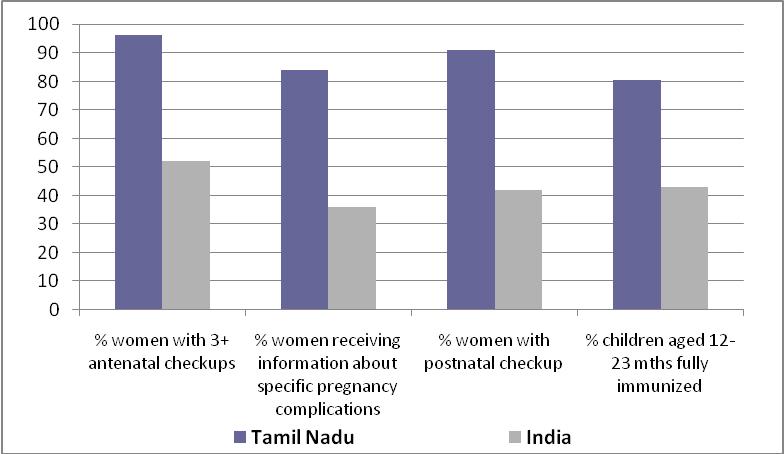
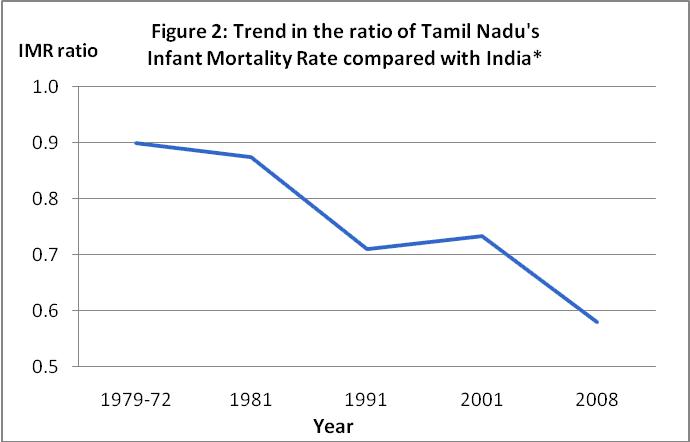
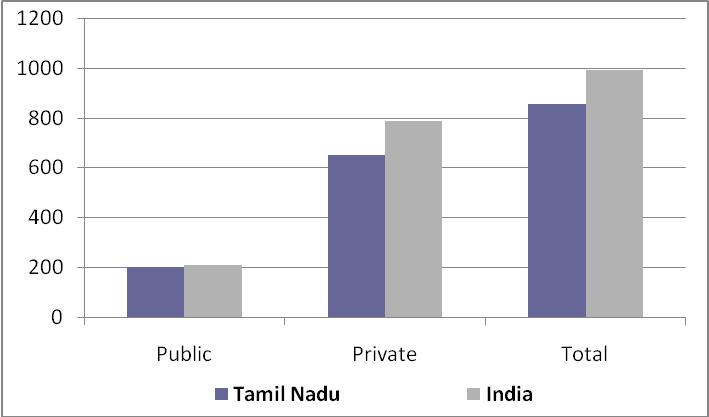
As the Financial Times article spells out, there was one very important exception to this herd mentality in the Indian health care system and that was the state Tamil Nadu. Tamil Nadu put more effort and resources into the public health services aspect. Things such as immunization for children, postnatal care for mothers. There were other variables which might have helped Tamil Nadu's superior health results to other Indian states, but there is no doubt that the different approach to the problem was a positive factor.
You can compare the results between Tamil Nadu and India in general in the 3 graphs at the links here, here, and here. The graphs are very enlightening, and many lessons for India in this paper and lessons for other countries in similar situation as India. Much of the findings were found in a paper Shankar Ankarya references in his article here: How might India’s public health systems be strengthened?” by Monica DasGupta, Rajendra Shukla, T V Somanathan and K K Datta, World Bank Policy Research Working Paper 5140, November 2009; and “How to improve public health systems: the lessons from Tamil Nadu”, by Monica DasGupta, B R Desikachari, T V Somanathan and P Padmanaban, World Bank Policy Research Working Paper 5073, October 2009.
I encourage all to read Shankar Ankarya's article and the referenced paper.
One factor to consider is the general health of the citizens/workers of the country. A healthy worker is an efficient worker, so we need to consider the current health situation and the steps being taken to improve it.
Currently people in India must tolerate very poor health. Roughly 40% of Indian children under three are stunted (short, not growing properly for their age). Nearly 80% of Indian children under age 3 are anaemic. Greater than 50% of married women (age 15-49) are anaemic. Even it's relatively common that affluent Indians will get diseases like hepatitis, malaria, diarrhea, and dengue or less commonly swine flu.
The economic costs of poor health of a country's general population can be enormous. Government spending on health in India accounts for just barely 1% of gross domestic product (GDP). The article goes on to point out the high importance of differentiating between "public health services" and "medical services". It breaks it up into 3 parts, the first 2 called "public health services" the 3rd called "medical services" and here I lift directly from Shankar Ankarya's article:
The first of the three numbered above, which can also be called "environmental health services" is the most important, and is really what demarcates the success in health rates of developed countries in comparison to countries such as India. Unfortunately, due to past policy errors "environmental health services" (number 1 above) has become the neglected ugly red-haired stepchild in most Indian states' health system.
- Population-wide preventive services to reduce exposure to disease through sanitary and health regulations and monitoring and averting health threats;
- Clinical preventive services provided to individuals such as vaccination and screening; and
- Medical services to care for and treat individuals with injuries and diseases.
Public health and medical health used to be separate bureaucracies in the government, but around 1947 they started to become unified. After they combined, medical services started to dominate the battle for talent and resources in the Indian states.
As the Financial Times article spells out, there was one very important exception to this herd mentality in the Indian health care system and that was the state Tamil Nadu. Tamil Nadu put more effort and resources into the public health services aspect. Things such as immunization for children, postnatal care for mothers. There were other variables which might have helped Tamil Nadu's superior health results to other Indian states, but there is no doubt that the different approach to the problem was a positive factor.
You can compare the results between Tamil Nadu and India in general in the 3 graphs at the links here, here, and here. The graphs are very enlightening, and many lessons for India in this paper and lessons for other countries in similar situation as India. Much of the findings were found in a paper Shankar Ankarya references in his article here: How might India’s public health systems be strengthened?” by Monica DasGupta, Rajendra Shukla, T V Somanathan and K K Datta, World Bank Policy Research Working Paper 5140, November 2009; and “How to improve public health systems: the lessons from Tamil Nadu”, by Monica DasGupta, B R Desikachari, T V Somanathan and P Padmanaban, World Bank Policy Research Working Paper 5073, October 2009.
I encourage all to read Shankar Ankarya's article and the referenced paper.
Sunday, February 21, 2010
To "Rocky" Obama and Congressional Dems: Pass The DAMN Bill
One of the goals of this site is to explain some complicated things in a way everyone can understand, yet not have any reader felt I insulted their intelligence. Well this isn't too complicated. Play the music "video" youtube link below and as you listen to the music read President Obama's words. Mr. President we've been waiting for this.
Remarks of President Barack Obama
Weekly Address
February 20, 2010
Weekly Address
February 20, 2010
The other week, men and women across California opened up their mailboxes to find a letter from Anthem Blue Cross. The news inside was jaw-dropping. Anthem was alerting almost a million of its customers that it would be raising premiums by an average of 25 percent, with about a quarter of folks likely to see their rates go up by anywhere from 35 to 39 percent.
Now, after their announcement stirred public outcry, Anthem agreed to delay their rate hike until May 1st while the situation is reviewed by the state of California. But it’s not just Californians who are being hit by rate hikes. In Kansas, one insurance company raised premiums by 10 to 20 percent only after asking to raise them by 20 to 30 percent. Last year, Michigan Blue Cross Blue Shield raised rates by 22 percent after asking to raise them by up to 56 percent. And in Maine, Anthem is asking to raise rates for some folks by about 23 percent.
The bottom line is that the status quo is good for the insurance industry and bad for America. Over the past year, as families and small business owners have struggled to pay soaring health care costs, and as millions of Americans lost their coverage, the five largest insurers made record profits of over $12 billion.
And as bad as things are today, they’ll only get worse if we fail to act. We’ll see more and more Americans go without the coverage they need. We’ll see exploding premiums and out-of-pocket costs burn through more and more family budgets. We’ll see more and more small businesses scale back benefits, drop coverage, or close down because they can’t keep up with rising rates. And in time, we’ll see these skyrocketing health care costs become the single largest driver of our federal deficits.
That’s what the future is on track to look like. But it’s not what the future has to look like. The question, then, is whether we will do what it takes, all of us – Democrats and Republicans – to build a better future for ourselves, our children, and our country.
That’s why, next week, I am inviting members of both parties to take part in a bipartisan health care meeting, and I hope they come in a spirit of good faith. I don’t want to see this meeting turn into political theater, with each side simply reciting talking points and trying to score political points. Instead, I ask members of both parties to seek common ground in an effort to solve a problem that’s been with us for generations.
It’s in that spirit that I have sought out and supported Republican ideas on reform from the very beginning. Some Republicans want to allow Americans to purchase insurance from a company in another state to give people more choices and bring down costs. Some Republicans have also suggested giving small businesses the power to pool together and offer health care at lower prices, just as big companies and labor unions do. I think both of these are good ideas – so long as we pursue them in a way that protects benefits, protects patients, and protects the American people. I hope Democrats and Republicans can come together next week around these and other ideas.
To members of Congress, I would simply say this. We know the American people want us to reform our health insurance system. We know where the broad areas of agreement are. And we know where the sources of disagreement lie. After debating this issue exhaustively for a year, let’s move forward together. Next week is our chance to finally reform our health insurance system so it works for families and small businesses. It’s our chance to finally give Americans the peace of mind of knowing that they’ll be able to have affordable coverage when they need it most.
What’s being tested here is not just our ability to solve this one problem, but our ability to solve any problem. Right now, Americans are understandably despairing about whether partisanship and the undue influence of special interests in Washington will make it impossible for us to deal with the big challenges that face our country. They want to see us focus not on scoring points, but on solving problems; not on the next election but on the next generation. That is what we can do, and that is what we must do when we come together for this bipartisan health care meeting next week. Thank you, and have a great weekend.
Wednesday, February 3, 2010
HOUSE DEMOCRATS---QUIT PUSSYFOOTING AND ACT LIKE MEN!!!!
The Huffington Post has a rock solid article by Sam Stein (dated Feb. 1). In the article, Senator Arlen Specter says using "reconciliation" to pass the health care bill is the best option available now. That way amendments to the bill could be passed "simultaneously" in order to compromise and appease House Democrats.
There are current discussions going on between both chambers (Senate and House of Rep.) and the White House. Many of those discussions between Harry Reid (Democrat of Nevada) and Rahm Emanuel, the President's "point man" on many Congressional issues. The House wants the Senate to go first, seemingly because Nancy Pelosi is a political coward and a cuhhh........nevermind.
What empty-headed politicians don't understand is, whatever votes they could lose by passing the bill they have already lost through months of staggered action, so voting for the health legislation now isn't going to cost them votes anyway, so they might as well get the benefit of passing the bill into law. PASS. THE. DAMN. BILL.
James Kwak explains thoroughly the drawbacks of the Republicans' best proposal at these three links here , here , and here. Oh James, next time you'll be saying the trading of Ann Taylor options on February 1 disproves the EMH. Darn you James!!! (haha, joking)
There are current discussions going on between both chambers (Senate and House of Rep.) and the White House. Many of those discussions between Harry Reid (Democrat of Nevada) and Rahm Emanuel, the President's "point man" on many Congressional issues. The House wants the Senate to go first, seemingly because Nancy Pelosi is a political coward and a cuhhh........nevermind.
What empty-headed politicians don't understand is, whatever votes they could lose by passing the bill they have already lost through months of staggered action, so voting for the health legislation now isn't going to cost them votes anyway, so they might as well get the benefit of passing the bill into law. PASS. THE. DAMN. BILL.
James Kwak explains thoroughly the drawbacks of the Republicans' best proposal at these three links here , here , and here. Oh James, next time you'll be saying the trading of Ann Taylor options on February 1 disproves the EMH. Darn you James!!! (haha, joking)
Monday, January 25, 2010
The Real Solution to Health Care Reform (Don't Miss This)
What exactly were the Democrats missing in the effort to pass Health Care Reform???? Well we think we found the answer. A Liam Show/Drama 34 Production.
Sunday, January 24, 2010
Some "Babysteps" President Obama Can Take to Progress Health Care Reform
David Ignatius of Washington Post makes some terrific (and well-advised) suggestions on baby-steps President Obama can take to break the delay of health care reform by obstructionist Republican Congressmen.
Subscribe to:
Posts (Atom)

 Posts
Posts